Thursday, December 30, 2010

Grain Mill


The grain mill finally arrived! Riley is seen here sniffing it and will give you an idea of the size of the mill. All the metal that you see is basically a vessel (hopper) to hold the unmilled grain while it feeds down onto the rollers. The metal rod sticking out the bottom right of the base area can either be attached to a hand crank to hand-mill the grain or an electric drill at about 500 rpm (guess which we will be doing). The brown particle board is shaped so that the mill can sit on top of a bucket and the milled grain will collect in the bucket below.


This is the view into the grain mill showing the rollers that crush the grain. The space in between is adjustable and the tighter the gap is, the more starches that will be available during the mash and the higher the efficiency will be. However, because the tighter crush will produce more flour from grinding the grain, the chances of having a stuck mash increase. So its a give and take between gap size, efficiency, and lautering ability. Most homebrew stores that have mills in them usually have a wider gap so that when new homebrewers go home and brew for the first time they dont get a stuck mash and are more likely to continue brewing and return to the store to buy more ingredients. Right now our efficiency is about 73% so it will be interesting to see what our efficiency jumps to with the finer crush.


This is a picture of the 50 lb sack of grain that I bought the other day. We will be buying a lot of these in the future and probably 3-4 different types of malt. Our standard American 2-row which we use in American style beers will be used the most. Pilsner malt is used in lagers and some Belgians Ales because of its cripsness and delicate flavor. Marris Otter is used in British style beers (like our First Snow) and in ales in which a "larger" malt presence is wanted; some people use MO in the IPAs, but it is common in porters and stouts as well. I've been looking at our recipes lately and it looks like we use a lot of Crystal 60L, a specialty malt that we use a lot, so we might buy a sack of that to save some money.


This is a picuture of the 5 gallons buckets that we will use to store the grain in instead of the big bag. The buckets are not airtight, but they are close enough and the lids will keep bugs and other things out of the grain. One sack of grain fits into 2 buckets that can be stacked on top of each other and stored easily.

Wednesday, December 29, 2010

Belgian Pale

Just finished cleaning up from today's brew sesh- 4 gallons of our Gold medal Belgian Pale Ale. The original recipe was written for 8 gallons, so instead of converting to 5 gallons, we just chopped the recipe in half. It was smooth brew day, we hit our volumes and numbers, and from start to finish, including cleanup, it was a 4 hour day.

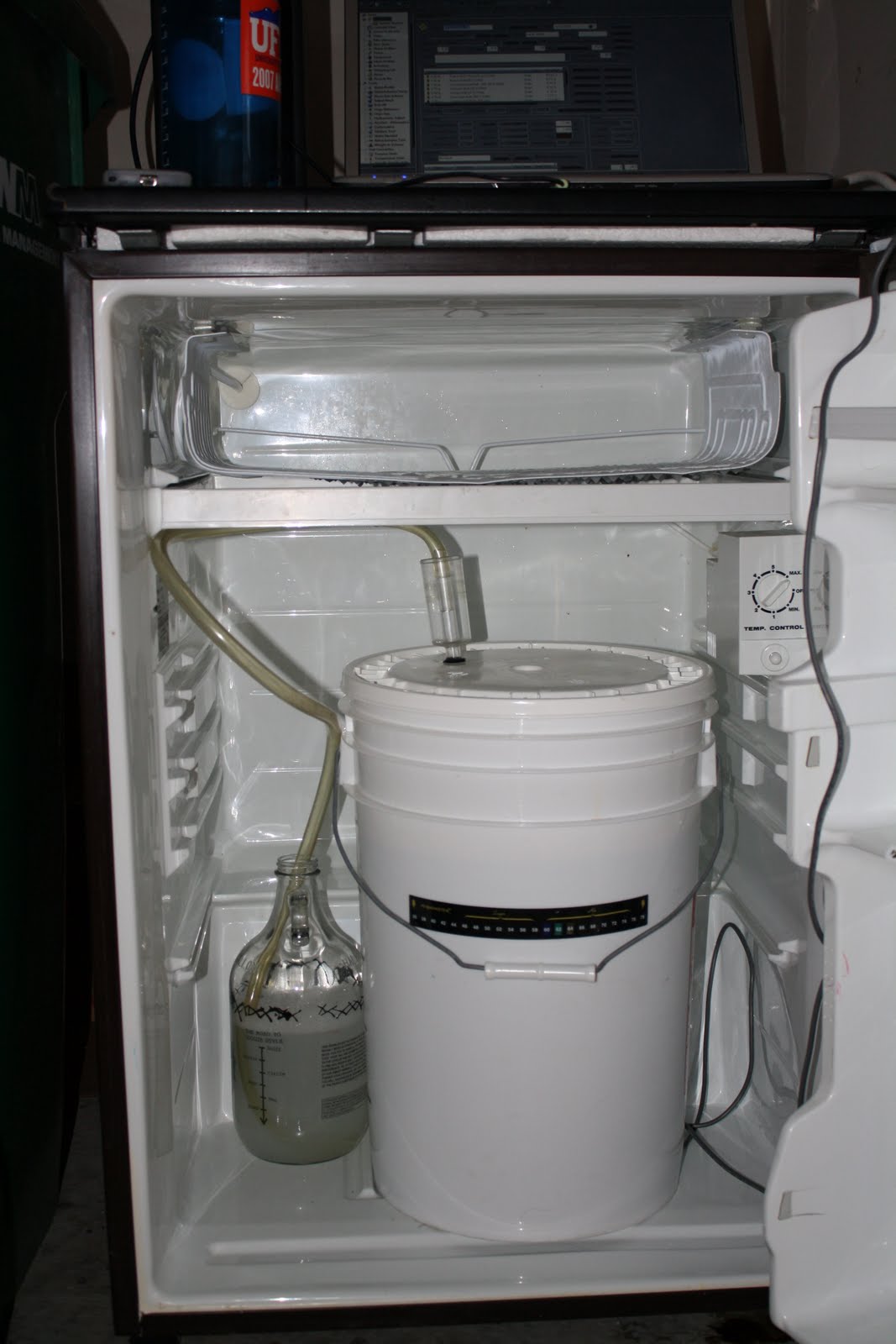
The fermentation fridge is being used for this batch although I am a little wary. The garage at this time of year is usually around 59-60, and when we arent brewing the fridge will be at that temp after 3 or 4 days. When it gets colder I have seen the fridge get down as low as 53 and the next few days its going to be very cold here in Denver. We are finally going to get some snow, but the overnight lows on Thursday and Friday are below 0. The Belgian yeast we use likes warmer temps, 67-71ish, and to make sure that it doesnt get too cold, I wrapped the fermenter in a blanket in the fridge. If it doesn't stay warm enough in the fridge I will have to bring the fermenter inside, but it will be harder to maintain a constant temperature. Hopefully the beer starts fermenting by this evening and will generate enough heat to keep it warm to last through the weekend.

In other news, we have purchased a grain mill and it should be here on Friday. With the new mill, we will be able to mill our own grain right before we brew. Some people say using fresh grain makes a difference, I dont know about that, but I do know we will be saving a lot of money. I bought a sack (50 lbs) of Pale 2-row which is our base malt thats makes up ~75-90% of a grain bill in most American styles of beer that we brew. Normally, the Pale 2-row is $1.50/lb, but I was able to get the sack for $45.50 or $0.90/lb. $45 is still a little high for a sack of grain, but now that we have a mill we can get in on a group buys with other hombrewers in the Denver area and get sacks for ~$25 ($0.50/lb). The grain mill was fairly expensive, but after a few sacks of grain, the mill will have paid for itself and we can a lot less expensively. Hopefully we will get the mill on Friday and I will post some picks of the mill and the sack of grain that we have right now.

Wednesday, December 15, 2010

Gold Medal Beer Results


Above are the pages that the judges filled out while judging our Belgian Pale. The first page is mostly a FYI type of page, but the last two are people's thoughts about the beers.

We just entered 4 more beers (Wee Heavy, Belgian Dubbel, Double Vision Barley Wine, and Elkie's First Snow) into another homebrew competition in Colorado. The Big Beers, Belgians, and Barley Wines is a homebrew competition and beer festival held every year in Vail to showcase big beers from around the country. They also have a homebrew competition in the same vain, so our biggest beers are the ones being entered (the Dubbel is the lowest of the bunch at a meager 7.5%). I dont expect to win anything in this competition as it is much much bigger and more competitive than the competition we won, but I do hope to have some high scoring beers and get some good feedback. We'll see what happens,


(You can click on the image to see a larger view)

Sunday, December 5, 2010

Rowdy Reptile Brewing: An Award Winning Brewery


Our Belgian Pale Ale took GOLD in a local Belgian/French Ale homebrew competition!!!This was our first entry into any competition, and who would have thought, we take home a Gold Medal. Hopefully, we get a plaque or a medal or something to hang up, but for now, we are just enjoying the win. I noticed the competition when I was picking up the ingredients for the IPA and when I got home I discovered that we only had 3 bottles left and the competition needs 2. Luckily, there was 1 left and we were able to taste our first gold medal beer.


PS If you click on the picture above you'll get a better view of the results page.

Friday, November 26, 2010

IPA

After waking from our food coma this morning we brewed another IPA. Compared to previous batches of IPA, this recipe was much simpler and had only 2 other malts. Other recipes have had up to 5 different types of grain and as a result the beers were too malty and sweet and the hop flavor was not as prominent as it should have been. I did make a slight mistake when I was shopping for the grains and switched one of the caramel malts with the amount for the biscuit malt. The beer will probably be a little sweeter and darker than originally planned but it shouldn't be too bad. This will probably be the last batch of beer before we make a lager at the very end of December/early January. When making lagers, after primary fermentation has been completed at ~49F, you raise the temperature of the beer to ~60-65 to perform a diacetyl rest. The rest allows the yeast to clean up off-flavors (diacetyl, which is a butterscotch type flavor) and then the beer will be lagered at 37F for 4 weeks. We are going to take advantage of the d-rest and brew a porter and ferment it in the fridge while the lager is sitting out. After that we will probably make a doppelbock that wont be ready to drink for ~6 months.


Side note, in 2010 to date we have brewed 94.5 gallons of beer. Legally, as a two-person household we can brew 200 gallons/year for personal conusmption, so we are under that but it is still a lot of beer.

Tuesday, November 9, 2010

First Snow


Its that time of the year, it has finally snowed here in Denver. Usually, we get snow much earlier than this, but better now than never. The reason that the first snow is important to us is becuase we brewed a beer on July 31st and bottled it on September 14th that was not to be opened until the first time it snows. The style of beer is an English Old Ale, a 8.4% dark malty beer perfect for dark, cold winter nights. After tasting this one, it is very good. It's sweet, thick, and the alcohol warms on the way down. Unfortunately, being 8.4% alcohol, it is not quite as carbonated as we would like after only 2 months in the bottle, but another 3-4 weeks and it will be fine. I am also guessing that in about 4-5 months when it mellows a little bit more that this beer is going to be really really good.

Also, when the first snow comes, we bring out Elky (for whom the beer is named) and he stays until the first rain storm in the spring.

Monday, November 8, 2010

Back in the game


Finally brewed again, this time we did a repeat batch, Bailey's Brown Ale. Same recipe as last, but a decrease in the chocolate malt from 8oz to 4oz. It is a good beer, but it is big, dark, and pretty strong; almost bordering on a porter. So, to take it a bit more towards a brown ale we dropped the chocolate a bit. We also treated the water with brewing salts. By making the Cl:SO4 ratio favor the Cl, the malt flavors will be more forward than the hop flavors in this beer. We'll see what effects that has on this batch and hopefully we will still have a couple of the old ones around to compare it too.

Also, this is the maiden voyage of the temperature controller we bought. The temp controller is used to set the fridge to whatever temperature we want. In the pic above you can see that it says 63. There is a sensor that goes into the fridge that we insulate against the side of the fermentor. Whenever the beer heats up during fermentation, the fridge will turn on and cool everything down to the desired temp. When the temp stabilzes, the fridge will turn off, and the cycle continues. By controller the temperature, we can control what kind of yeast characteristics we want. Lower temperatures will be very clean and neutral and almost lager-like, while higher temps will impart more fruity flavors.
This will also allow us to finally attempt to make some lagers. Lagers normally ferment in the high 40s/low 50s, and then require 2-6 weeks at 34 degrees to "lager." When the brown is complete and ready to bottle (around Thanksgiving) we are going to brew a schwarzbier (black lager). Schwarzbiers are kind of like "black pilsner" in that they are not very roasty or heavy like a stout, but are dark in color and generally lower in alcohol, ~5%. Here is a link to description of a schwarzbier. The main reason we are also making a lower alcohol lager is so we can use that yeast to make a high alcohol doppelbock. Lagers normally require 2x the amount of yeast ales do, and for just the schwarz we will have to make 2 different starters to get enough yeast. It would probably take us a month of making starters to make enough yeast for the doppelbock. Instead of making a bunch of small starters, we are essentially makaing a 5 gallon starter that we get to drink later. The doppelbock will probably be brewed right around Janurary 1st and we are thinking of using that as our First Snow beer for next winter. That way it will have about 2 months of lagering, and about 6 months in the bottle to age before we crack one open.
The only problem now with having the fridge and making lagers, is that there will be a lot longer time between batches if we want to use the fridge becuase lagers require such a long time.....Best solution= new fridge and temp controller :)